
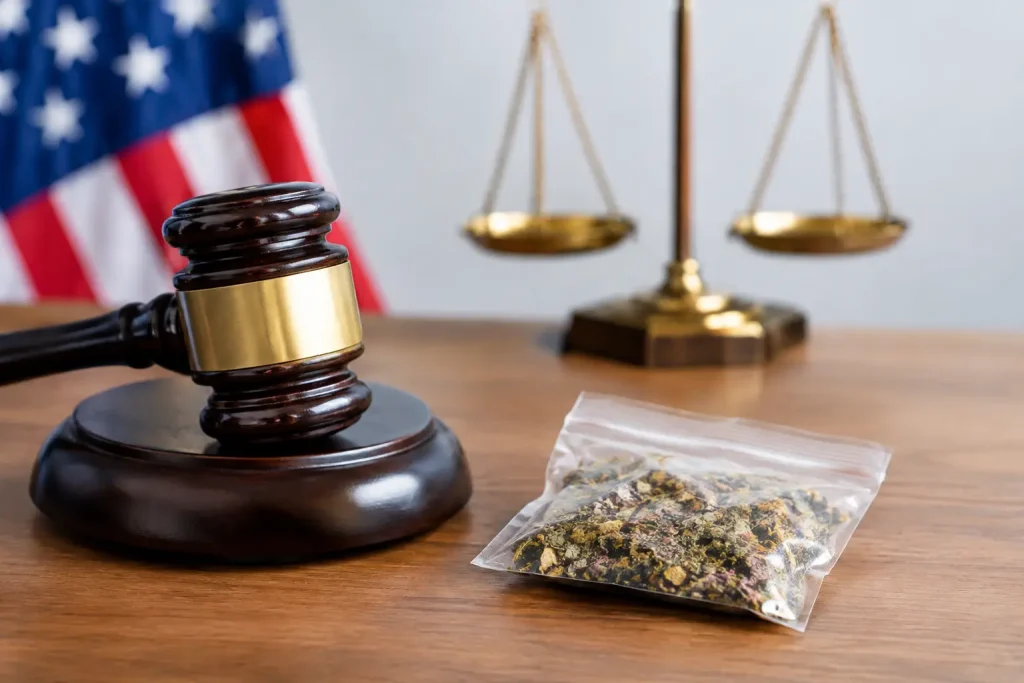
A package can look professionally labeled, be sold online, and carry terms such as herbal incense or not for human consumption. None of that answers the question buyers actually need answered: is K2 Spice legal in the United States? In most real-world situations, the answer is no, or at minimum, legally uncertain enough to carry serious risk.
K2, Spice, synthetic cannabinoids, liquid incense, and sprayed herbal blends are broad marketplace labels, not legal classifications. The law generally focuses on the actual chemical ingredients, how closely a substance resembles a controlled drug, what it is intended to do, and the state where it is possessed, sold or shipped. That makes this category far more complicated than a simple legal-or-illegal label.
Is K2 Spice Legal in the United States?
Many products historically sold as K2 or Spice contain synthetic cannabinoids, chemicals designed to act on some of the same brain receptors as THC. A substantial number of these compounds are controlled under federal law. Possessing, manufacturing, distributing, importing, or selling a federally controlled synthetic cannabinoid outside authorized research or medical channels can expose a person to criminal penalties.
Federal law has also changed over time as new compounds appeared. When one chemical is specifically scheduled, sellers may try to market a different formula. That does not automatically make the replacement lawful. Federal authorities can place substances into controlled schedules, and other laws may apply even before a specific compound becomes widely known by name.
The practical takeaway is straightforward: a product called K2, Spice, herbal incense, potpourri, or liquid spray should not be assumed legal because of its branding, packaging, or availability on a website. Legal status depends on verifiable chemistry and applicable law, not marketing language.
Why Names and Labels Do Not Set the Law
The K2 market has long used broad product names that do not reliably identify a formula. One batch, brand, or package design can differ from another. A label may omit active ingredients, use a generic botanical description, or list a compound that does not match the actual contents. This creates both legal uncertainty and a major safety problem.
A not for human consumption statement is not a legal shield. Authorities may consider the full context, including advertising, product format, claimed effects, customer communications, pricing, product instructions, and evidence of intended use. Simply printing a disclaimer does not turn a controlled substance into a lawful consumer product.
Likewise, calling a product research material does not make it lawful for ordinary retail use. Legitimate research activity involves institutional controls, documented purpose, qualified handling, and compliance obligations. A casual label cannot replace those requirements.
Federal Scheduling and the Analog Act
At the federal level, specifically listed synthetic cannabinoids can be treated like other Schedule I controlled substances. Schedule I is the most restrictive federal category and includes substances the federal government considers to have a high potential for abuse and no accepted medical use under federal law.
There is another issue buyers often overlook: the Federal Analog Act. In general terms, this law can allow certain substances that are substantially similar to a controlled drug in chemical structure and actual or intended effect to be treated as controlled-substance analogs when intended for human consumption. Whether the Act applies is highly fact-specific and can depend on chemistry, intent, evidence, and court interpretation.
That uncertainty is not a loophole to rely on. It is the opposite. A formula that is not plainly named on a federal schedule may still create legal exposure under analog-law theories, particularly where evidence suggests it was meant to produce drug-like effects in people.
State Laws Can Be Stricter Than Federal Rules
Federal law is only one part of the picture. States often have their own controlled-substance schedules, synthetic-drug statutes, analog laws, consumer-protection laws, and emergency scheduling powers. Some states list large families of synthetic cannabinoids rather than waiting to ban each compound individually. Others use broad language intended to cover chemically related variants.
That means a substance can create a state-law problem even if a buyer believes it falls into a gray area federally. Local ordinances and law-enforcement priorities may also differ. Transporting a product across state lines can add another layer of risk because multiple jurisdictions may become relevant.
For consumers, retailers, and distributors, the rule is simple: do not treat another state’s rules as permission in your state. A product’s legal status can change based on location, updated schedules, and the actual lab-verified composition of that specific item.
Legal High Marketing Is a Red Flag, Not Proof
Terms such as legal high, federal legal, compliant, or undetectable are marketing claims, not legal determinations. In a fast-changing chemical category, those statements can become outdated quickly. They may also ignore state law, analog laws, import restrictions, or the possibility that a product does not contain what its packaging claims.
A responsible buyer should be skeptical of any seller that promises certainty without identifying the applicable jurisdiction, the precise ingredient, and the date of the legal review. Even then, only qualified legal counsel can advise on a particular situation.
Claims about potency deserve the same caution. Synthetic cannabinoids can be active at very small amounts, and an unevenly sprayed plant material or liquid formulation may not distribute chemicals consistently. This is not comparable to evaluating a standard, regulated consumer product with reliable labeling and quality controls.
Health Risk and Legal Risk Often Travel Together
The legal question matters but it is not the only concern. Synthetic cannabinoids have been associated with severe and unpredictable reactions, including anxiety, agitation, confusion, rapid heart rate, vomiting, seizures, psychosis, loss of consciousness, and dangerous behavior. Risks can rise when a product’s ingredients are unknown, mislabeled, unusually concentrated, or mixed with other substances.
If someone has chest pain, trouble breathing, a seizure, severe confusion, collapses, or becomes a danger to themselves or others after using a suspected synthetic cannabinoid product, call 911 immediately. Do not wait for the effects to wear off. Emergency clinicians need accurate information about what may have been taken, even if the product name is vague.
For households, retailers, and distributors, unknown formulas also create practical liability concerns. A product that is mislabeled, contaminated, or later determined to contain a controlled substance can lead to far more than a rejected shipment. The consequences may include seizure, criminal investigation, civil claims, payment processing problems, and lasting reputational damage.
How to Think About Compliance Without Guesswork
The safest approach is not to search for a technicality in a changing market. It is to treat unidentified or synthetic-cannabinoid products as high-risk unless their legal status is independently confirmed by a qualified attorney familiar with federal and state controlled-substance law.
For businesses, compliance requires more than a disclaimer or a confident product description. It requires accurate ingredient documentation, credible independent testing, current legal review, careful supplier controls, and a willingness to stop offering products when the law or evidence creates uncertainty. Quality-first standards mean refusing to make legality promises that cannot be supported.
For individuals, avoid relying on forum posts, old product pages, social media claims, or packaging statements. If legal consequences matter in your situation, consult a licensed attorney in your state. If health is the immediate concern, seek medical help rather than trying to identify a mystery product through its brand name.
The most useful answer is also the most honest one: K2 and Spice products are not a reliably legal category in the United States. When the ingredients are unclear, the formula is changing, or the claims sound too certain, caution is the only premium choice.